
What does it really take to create meaningful change for animals?
Sometimes it happens through quiet conversations with corporations. Sometimes it takes thousands of people speaking up. And sometimes it requires advocates willing to get uncomfortable to bring attention to something that can no longer be ignored.
On this episode of the Better Life for Animals Podcast, Cheryl Moss talks with Amber Canavan, Associate Director of Vegan Campaigns at PETA, whose more than two decades of advocacy have included corporate campaigns, protests, legislation, investigations, and animal rescue.
Their conversation is a reminder that progress rarely comes from one person or one strategy. It happens when people continue showing up for animals.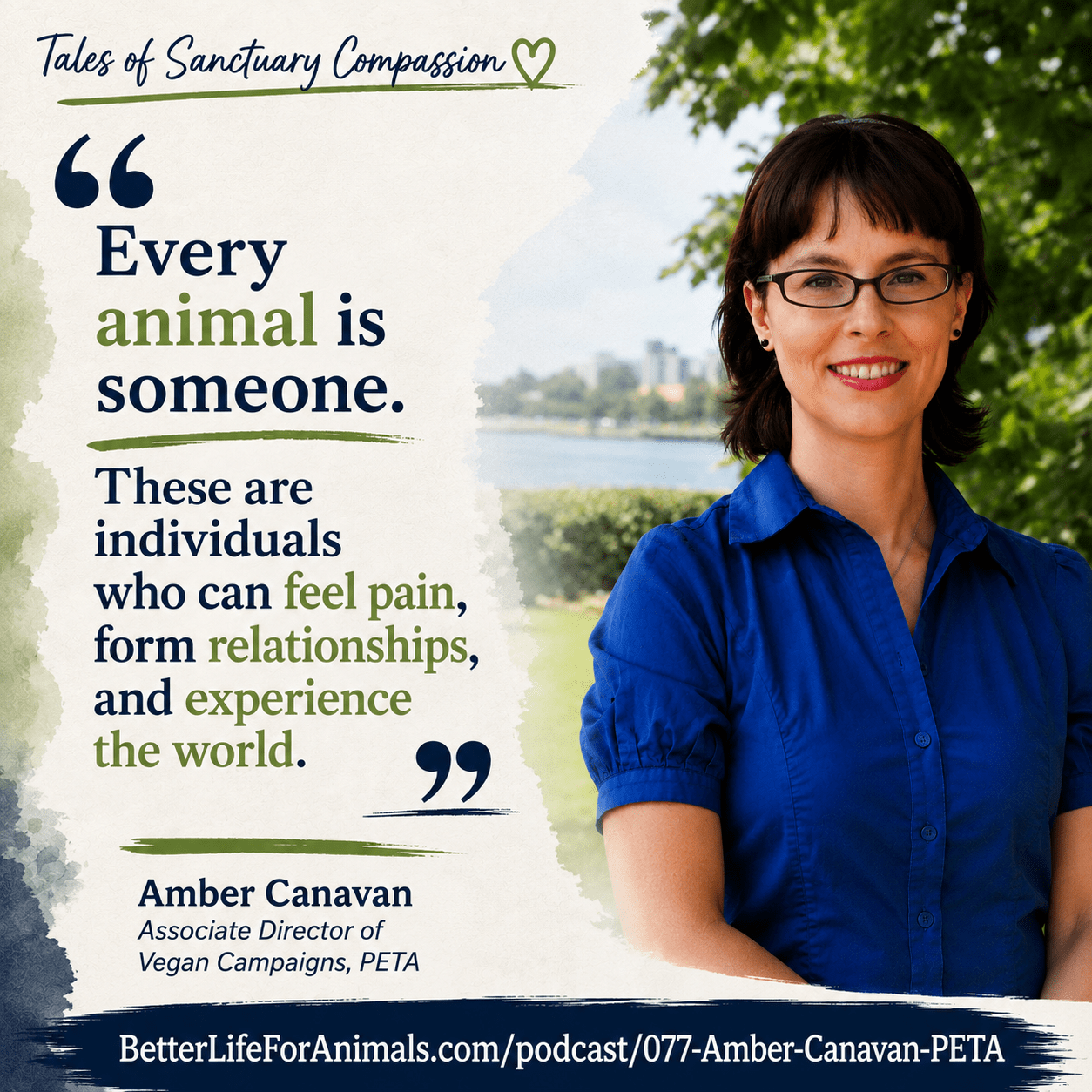
Discovering What Was Hidden
Amber’s journey into animal advocacy began while researching a high school paper. Already someone who cared deeply about animals and nature, she began discovering information about the way animals were treated that she had never encountered before.
That discovery changed the direction of her life.
After more than 23 years as a vegan, Amber has also witnessed significant changes in public attitudes. Early in her advocacy, she sometimes had to convince people that chickens, dogs, and cats experienced pain and emotions. Today, the conversation has moved forward, even though there is still a tremendous amount of work to be done.
Behind the Headlines
PETA is known for bold protests, but Amber explains that some of the organization’s most successful work happens quietly.
Calls are made. Emails are sent. Meetings take place. Companies are given opportunities to change their policies before a protest sign ever appears.
When those efforts do not work, public pressure may become necessary.
One example was PETA’s campaign urging Starbucks to eliminate its surcharge for plant-based milk. The additional charge made choosing a vegan alternative more expensive, and PETA believed changing Starbucks’ policy could influence the larger coffee industry.
 The campaign included corporate outreach, shareholder involvement, billboards, protests, work-ins, and celebrity participation. Amber even glued her hand to a Starbucks counter during one protest.
Yet she emphasizes that the eventual change was not the result of one dramatic action. It came from many people continuing to apply pressure over time.
Giving More Than 400 Hens a Second Chance
One of the most moving parts of the conversation involves Amber’s role in rescuing approximately 435 hens from an Oregon egg facility that was shutting down.
The birds had been used for egg production and were only about 17 months old. Many were suffering from the effects of crowding, stress, and the conditions in which they had lived.
The rescued hens were placed with reputable sanctuaries and adoptive homes. Amber adopted several herself and watched as their personalities began to emerge.
Seeing these hens experience grass and sunlight and finally have the opportunity to simply be chickens reinforced something Amber already knew. Animals are remarkably resilient when given the chance to heal.
For Cheryl and the mission of Better Life for Animals, their story is also a powerful reminder of why supporting reputable sanctuaries matters.
When Cruelty Is Hidden in the Supply Chain
Amber also discusses PETA’s campaign addressing forced monkey labor in Thailand’s coconut industry.
Investigations by PETA Asia documented monkeys being tethered and forced to harvest coconuts. PETA responded through corporate outreach, public action alerts, investigations, and protests, eventually influencing major retailers to change sourcing policies involving brands connected to the investigations.
It is a striking example of how animal exploitation can be hidden within products consumers may never think to question.
Turning Advocacy Into Lasting Change
The conversation also explores legislative efforts surrounding foie gras. Amber has personally witnessed conditions inside foie gras production and has brought that experience into legislative advocacy.
She explains that corporate campaigns and legislation can work together. Advocates may convince individual restaurants or companies to stop selling a cruel product, while legislation can create broader and more lasting protections.
Progress, however, can be painfully slow. Bills stall. Campaigns take years. Legal challenges happen.
Amber’s response to those setbacks is summed up in one powerful thought: “Activism is the antidote to despair.”
Every Animal Is Someone
Ultimately, lasting change requires changing the way society sees animals.
Throughout the conversation, Amber returns to the importance of recognizing animals as individuals capable of experiencing pain, comfort, fear, attachment, and loss.
That shift can begin with something as simple as hearing an animal’s story.
Not everyone needs to lead a protest or become a lobbyist. Advocacy can mean contacting a company, supporting a sanctuary, sharing information, participating in an action alert, making different consumer choices, or simply speaking up when an animal needs someone to do so.
Some victories make headlines. Others happen quietly after an email, phone call, or conversation.
Either way, when cruelty stops and animals are spared, the effort matters.
And every person willing to take action can become part of that cha
Episode Highlights
[00:00] Introduction
[02:30] It all started with a highschool paper
[06:00] Disruptive activism vs quiet resolve
[08:30] Vegans penalized by Starbucks
[14:00] The mission of “Hell on Wheels”
[16:30] The deception of the label “caged free chickens”
[22:00] Exploitation of monkeys for coconut milk
[28:00] Duck exploitation for Foie Gras
[32:00] The power of voting
[35:45] Being part of the change
About Amber Canavan
Amber Canavan is the Associate Director of Vegan Campaigns at People for the Ethical Treatment of Animals (PETA), where she focuses mainly on helping animals used for food. Her victories include persuading Costco, Target, and Albertsons to stop selling coconut milk sourced from brands that depend on forced monkey labor in Thailand; getting Kikkoman to end decades-long experiments on animals; and compelling Starbucks, Dutch Bros, and other coffee chains to drop their vegan milk upcharge. Before coming to PETA, she earned a bachelor’s degree in environmental studies from the SUNY College of Environmental Science and Forestry.
www.Peta.org
About Cheryl Moss
Cheryl Moss is the host of the Better Life for Animals podcast, where she shares uplifting stories from sanctuaries and highlights the work of vegan activists, ethical consumers, and animal welfare leaders. She is also the founder of the Funding Blueprint for Sanctuaries summit, designed to empower those involved with sanctuaries to create sustainable funding streams.
A passionate advocate for animal welfare, Cheryl is dedicated to ending factory farming and supporting underrepresented sanctuaries.
Beyond podcasting, Cheryl is a banking professional and an accomplished children’s author. A graduate of Main Street Vegan Academy, she recently added Vystopia Transformation to her resume. The Vystopia work, created by psychologist Clare Mann, focuses on the emotional impact many people experience after becoming aware of animal suffering and exploitation. The training offers tools for resilience, communication, and emotional well-being while continuing to advocate for positive change.
Through her books, Gabriel, Cluck, and Pickle the Pig, Cheryl inspires young readers to embrace kindness, sustainability, and compassion for animals.
When not advocating, she enjoys Pilates and spending time with her rescue dogs and grandchildren. Through her work, writing, and activism, Cheryl continues to inspire positive change for animals and the planet.
https://www.facebook.com/BLFAnimals/
https://www.instagram.com/betterlife4animals/
https://www.linkedin.com/in/cherylmossabetterlifeforanimals/
