
Pigeons are everywhere. We see them in city squares, train stations, parking lots, parks, and perched on the ledges of buildings. Yet for all their familiarity, few animals are as misunderstood or dismissed.
In this episode of the Better Life for Animals Podcast, Cheryl Moss talks with Susan Joyce, affectionately known as “The Pigeon Lady,” about the birds that unexpectedly became the focus of her life. Susan spent years rescuing and rehabilitating pigeons, at one point caring for approximately 400 birds. Today, she focuses much of her work on advocacy, education, fundraising, and supporting those who continue doing hands-on pigeon rescue.
How It All Began
Susan’s journey began while working in veterinary practice. After breaking her back, she could no longer spend her days working in surgical theaters and moved to the front of the veterinary hospital. There, she began noticing injured birds being brought in and euthanized, often without receiving the consideration she believed they deserved.
Susan started asking questions and eventually requested space where she could care for the birds herself.
Ironically, pigeons were not the birds she wanted to handle. Someone else at the practice cared for them until that person left. Suddenly, Susan found herself responsible for pigeons and quickly discovered that everything she thought she knew about them was wrong. The birds she had once thought of as pests were intelligent, fascinating individuals deserving of the same compassion as any other animal.
The Truth About Pigeons
 One of Susan’s goals is to challenge the assumptions people have about pigeons. She explains that humans domesticated these birds over thousands of years and eventually abandoned them. The feral pigeons living in our cities today are there in large part because of their long relationship with us. Our buildings even resemble the rocky ledges and crevices their ancestors used for nesting.
Pigeons are also remarkable parents. Both parents care for their young, producing nutrient-rich crop milk to feed their babies. Even their famously simple nests make sense when we understand their history. Their ancestors nested on rocky ledges where elaborate nests simply were not necessary.
When Rescue Becomes Unsustainable
Susan also speaks candidly about a reality many people in animal rescue face. Caring for hundreds of pigeons required food, veterinary care, facilities, volunteers, and significant financial resources.
Eventually, the financial pressure became overwhelming. Susan experienced homelessness, living for a period in a tent and later a caravan while continuing to devote her resources to the birds.
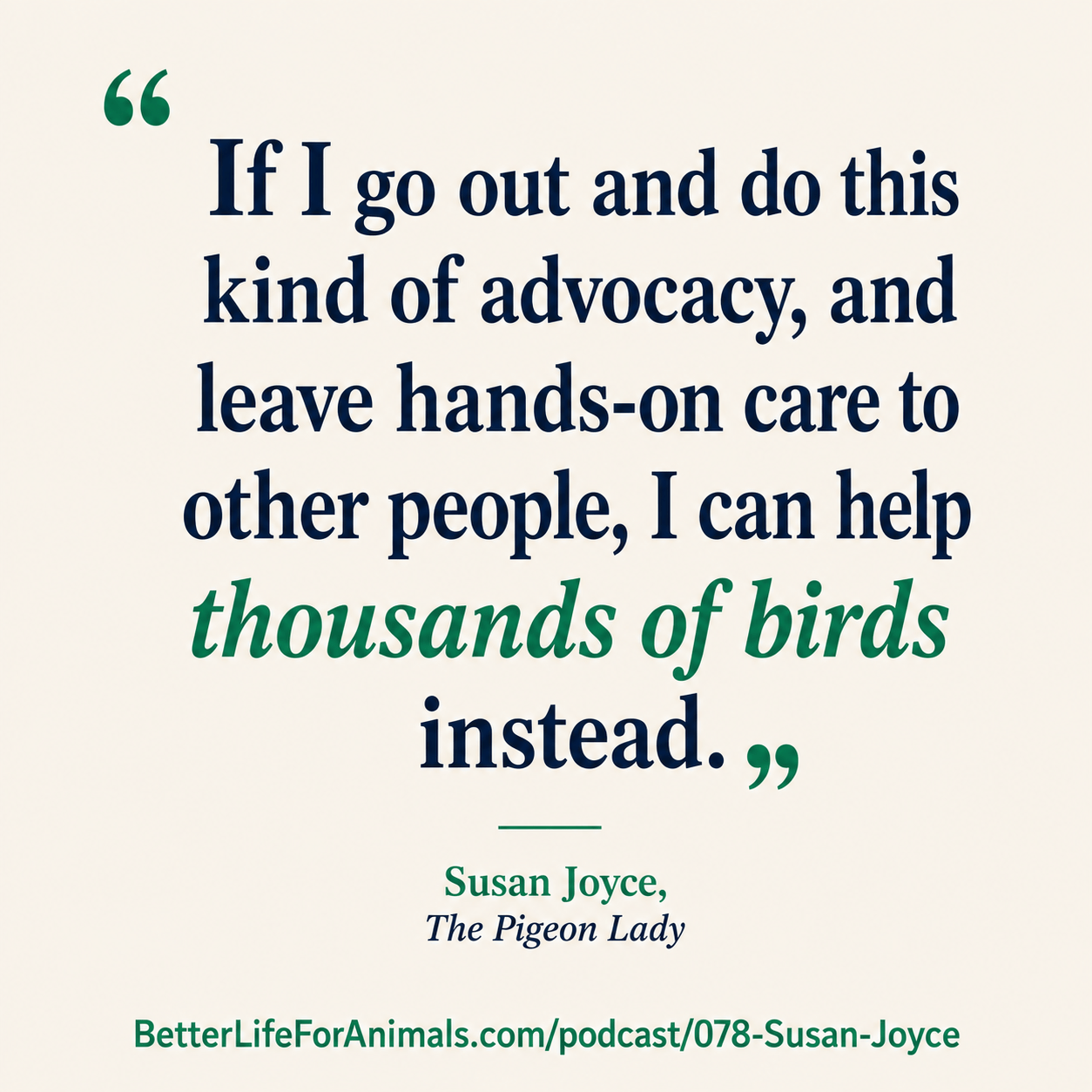
She eventually recognized that caring for animals cannot come at the expense of making the entire rescue operation unsustainable. Susan closed her sanctuary and arranged for the pigeons to move to other sanctuaries, while her association continued helping fund their care. She also realized that by using her voice as an advocate, she could potentially help thousands of pigeons rather than personally caring for hundreds.
What to Do If You Find an Injured Pigeon
Susan offers important advice for anyone who encounters a pigeon that appears injured or ill. If you can easily approach and pick up the bird without the pigeon attempting to escape, the bird likely needs help.
One of her strongest cautions is not to immediately give an injured pigeon food or water. Instead, safely contain the bird in a ventilated cardboard box or other secure container, protect the pigeon from further danger, and locate an experienced pigeon or wildlife rehabilitator who can provide appropriate care.
Changing the Way We See Them
Susan believes attitudes toward pigeons are beginning to change. More people are noticing their personalities, learning about their behavior, and questioning why these birds have been treated so differently from other animals.
Her work asks us to consider a much larger question: Why do we rush to protect some animals while barely noticing others?
Pigeons have lived alongside humans for thousands of years. Susan’s message is a reminder that familiarity should not make an animal less worthy of our attention. Sometimes compassion begins when we stop seeing a nuisance, a flock, or a category and start seeing the individual animal standing in front of us.
And for the pigeons Susan Joyce has spent years defending, being truly seen may be where change begins.
Episode Highlights
[00:00] Introduction
[01:00] How the “Pigeon Lady” came to be
[04:30] What makes pigeons special
[09:00] Treating pigeons with compassion
[13:00] The challenge with domestic pigeons
[17:30] A typical day for the Pigeon Lady is not so typical
[25:00] Pigeon contraceptives: good or bad?
[33:00] Funding through collaboration
[37:00] Change is coming
About Susan Joyce
Susan Joyce, also known as “Sue the Pigeon Lady,” is a UK-based animal advocate and founder of Little Green Pigeon C.I.C. and the National Pigeon Advocacy Association. With a background in veterinary practice, she went on to run a large pigeon sanctuary before moving into full-time advocacy.
Sue now travels across the UK delivering talks, outreach, and national campaigns to change public perception and improve the welfare and protection of pigeons. Through her work, media appearances, and public speaking, she is helping to build a growing movement of compassion for one of the most misunderstood animals in the World. She also hosts the annual International Pigeon Advocacy Conference.
Alongside her pigeon advocacy work, she is co-founder of the Animal Rights Choir and is also heavily involved with two major UK vegan festivals, as a co-organiser and MC.
@littlegreenpigeon @suethepigeonlady @animalrightschoir @pigeon.advocacy.association.uk @internationalpigeonconference
www.suejoyce.com
www.nationalpigeonadvocacyassociation.co.uk
About Cheryl Moss
Cheryl Moss is the host of the Better Life for Animals podcast, where she shares uplifting stories from sanctuaries and highlights the work of vegan activists, ethical consumers, and animal welfare leaders. She is also the founder of the Funding Blueprint for Sanctuaries summit, designed to empower those involved with sanctuaries to create sustainable funding streams.
A passionate advocate for animal welfare, Cheryl is dedicated to ending factory farming and supporting underrepresented sanctuaries.
Beyond podcasting, Cheryl is a banking professional and an accomplished children’s author. A graduate of Main Street Vegan Academy, she recently added Vystopia Transformation to her resume. The Vystopia work, created by psychologist Clare Mann, focuses on the emotional impact many people experience after becoming aware of animal suffering and exploitation. The training offers tools for resilience, communication, and emotional well-being while continuing to advocate for positive change.
Through her books, Gabriel, Cluck, and Pickle the Pig, Cheryl inspires young readers to embrace kindness, sustainability, and compassion for animals.
When not advocating, she enjoys Pilates and spending time with her rescue dogs and grandchildren. Through her work, writing, and activism, Cheryl continues to inspire positive change for animals and the planet.
https://www.facebook.com/BLFAnimals/
https://www.instagram.com/betterlife4animals/
https://www.linkedin.com/in/cherylmossabetterlifeforanimals/
