
There is something powerful about the way young people see the world. They are often willing to question things the rest of us have learned to accept without much thought. When it comes to animals, those questions can be especially revealing.
Why do we consider some animals members of the family while treating others very differently? Why is cruelty unacceptable when it happens to a dog or cat, yet the suffering of other animals is often ignored? Why do certain practices continue simply because they have always been done that way? And perhaps most importantly, if something is causing animals to suffer, what can we do to change it?
These are not insignificant questions. They are the beginning of awareness, and awareness is often the beginning of advocacy.
For young people who already feel a strong connection to animals, discovering that they can actually do something with that compassion can be life-changing. They may not yet know what animal advocacy looks like or where they fit into it. What they often do know is that animals matter to them and they want their actions to reflect that.
The opportunity we have as adults is to take that concern seriously.
Compassion Can Become Action
Caring about animals is a wonderful starting point, but compassion becomes far more powerful when someone learns how to put it into action. This is especially important for young people because many simply don’t know how many opportunities exist to help animals.
A teenager interested in science may assume becoming a veterinarian is the only career available to someone who wants to work with animals. A student interested in law may never have heard of animal law. Someone who spends hours creating social media content may not realize those same skills can educate thousands of people about animal welfare and animal rights. A young person who naturally brings people together may already possess the beginnings of the skills needed to organize a community campaign.
There are opportunities in education, veterinary medicine, law, nonprofit leadership, sanctuary work, communications, fundraising, public policy, grassroots organizing, journalism, research, social media, and countless other areas.
Young people need exposure to those possibilities.
More importantly, they need opportunities to meet people doing this work and discover that most advocates did not begin with everything figured out. They started because something mattered enough for them to take the next step.
That next step can be surprisingly small. It might be volunteering at a sanctuary, researching an issue for a school project, organizing a fundraiser, writing to an elected official, changing personal choices, creating educational content, or starting a conversation with friends.
Those actions may seem small individually, but they teach an important lesson: you do not have to wait until you are older to make a difference.
Giving Young People a Place in Animal Advocacy
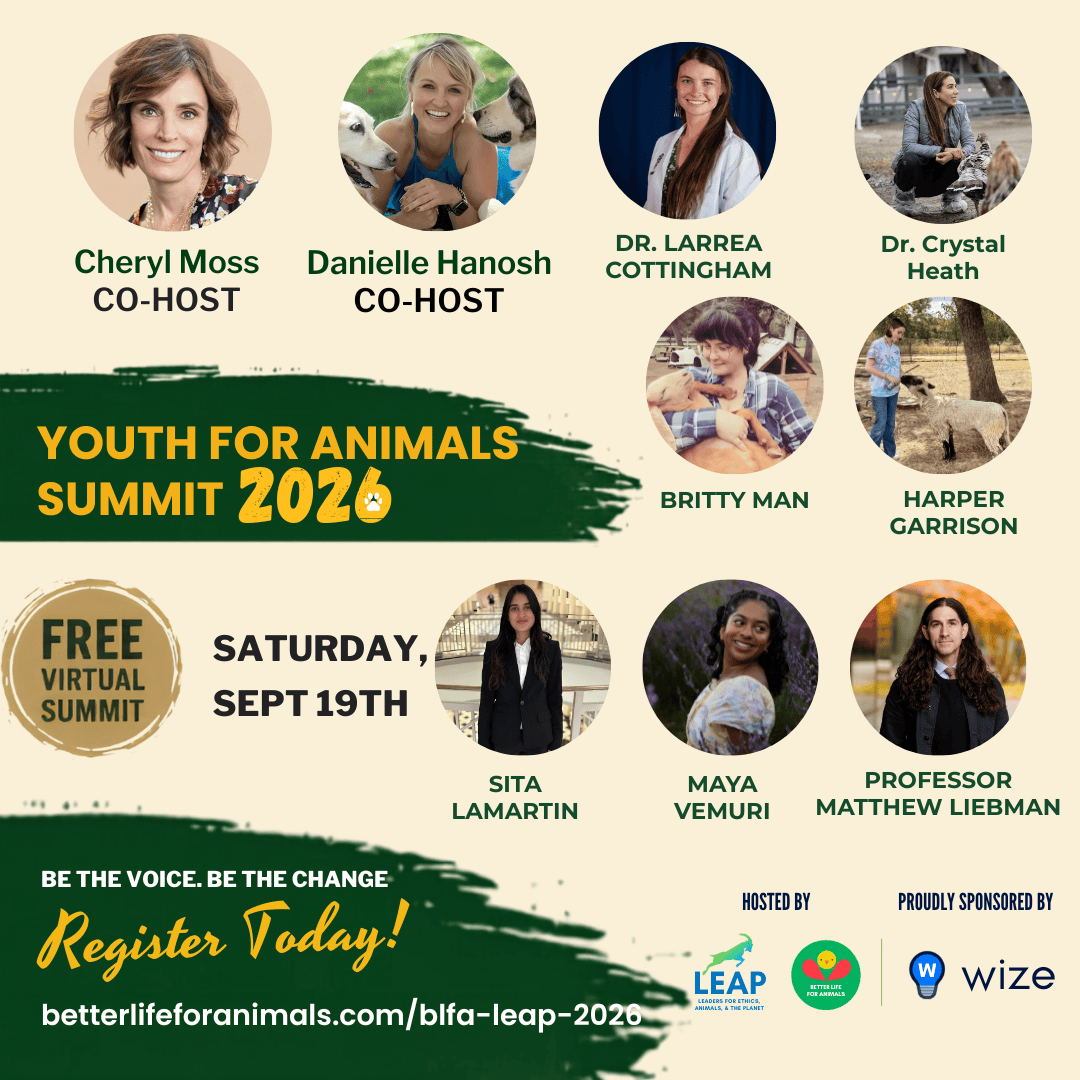 This belief is at the heart of the Youth for Animals Summit 2026, a free virtual event presented by Better Life for Animals and LEAP, Leaders for Ethics, Animals, and the Planet, on Saturday, September 19.
The summit was created to give young people an opportunity to learn about animal advocacy from people approaching the work from very different directions.
Speakers include Harper Garrison, Britty Man, Dr. Crystal Heath, Dr. Larrea Cottingham, Professor Matthew Liebman, Maya Vemuri, and Sita Lamartin. Throughout the day, participants will explore subjects including grassroots advocacy, veterinary medicine, animal law, social media, careers helping animals, organizing, and youth leadership.
Rather than simply telling young people that they can make a difference, the summit is designed to help them understand how that can happen. Participants will have opportunities to learn, ask questions, explore ideas, and discover practical ways to become involved.
There is no requirement that someone already consider themselves an animal advocate. There is no expectation that they know exactly what they want to do. Curiosity and compassion are enough to begin.
Parents, educators, homeschool families, sanctuary professionals, youth organizations, and adults who support young people are also encouraged to participate. Adults have an important role in this conversation because encouragement from even one person can dramatically influence whether a young person pursues something they care about.
The Importance of Being Taken Seriously
One of the greatest gifts we can give a young person is to take their concerns seriously.
When a child expresses sadness about an animal being hurt, there is an opportunity for a conversation. When a teenager questions where food comes from, there is an opportunity for education. When a student becomes passionate about wildlife, farmed animals, shelter animals, animal testing, or another issue, there is an opportunity to help them learn more.
We don’t have to provide every answer. In fact, some of the most meaningful conversations begin when we explore the answers together.
What matters is that we don’t dismiss their concern simply because of their age.
Many adults involved in animal advocacy can trace their commitment back to an experience they had when they were young. Perhaps it was a relationship with a particular animal. Maybe they witnessed cruelty. They might have visited a sanctuary, watched a documentary, read a book, met an advocate, or learned something they simply could not forget.
Experiences like these can influence choices for decades.
Imagine what can happen when that initial spark of compassion is followed by education, mentorship, encouragement, and opportunity.
Every Young Advocate Will Find Their Own Way
Not every young person who cares about animals will become a veterinarian or an attorney. Not everyone will start an organization, speak at rallies, or dedicate their career exclusively to animal advocacy.
They don’t have to.
Helping animals can become part of almost any life or profession. A business owner can make compassionate decisions. A teacher can introduce humane education. A writer can tell stories that change perspectives. A filmmaker can expose cruelty that would otherwise remain hidden. A scientist can advance alternatives to animal testing. A social media creator can introduce thousands of people to ideas they have never considered.
There is room for different personalities, interests, abilities, and levels of involvement.
That is one of the most important messages we can give young people. Advocacy is not reserved for a certain kind of person. You don’t have to be the loudest person in the room to have influence, and you don’t need a large audience to make meaningful change.
Sometimes advocacy begins quietly, with one decision to live more consistently with what you believe.
Who Will You Invite?
As the Youth for Animals Summit approaches, I encourage you to think about the young people already in your life. Perhaps there is a student who talks constantly about animals, a teenager who follows rescue organizations online, a child who asks difficult questions about how animals are treated, or a young volunteer who lights up every time they visit a sanctuary.
Invite them to participate.
A single day won’t answer every question or solve every problem facing animals. That’s not the point. The opportunity is to expose young people to ideas, people, careers, and possibilities they may never have encountered before.
One presentation could introduce a student to a career they didn’t know existed. One speaker’s story could give a teenager confidence to start a project. One answer during a Q&A could help someone realize that the concern they have carried quietly for years is shared by many others.
We may never know which moment becomes the moment that changes someone’s direction.
Youth for Animals Summit 2026
The Youth for Animals Summit 2026 takes place Saturday, September 19, 2026, from 10:00 a.m. to 4:00 p.m. Pacific. The event is 100 percent virtual and registration is free.
The summit is presented by Better Life for Animals and LEAP, Leaders for Ethics, Animals, and the Planet, and is proudly sponsored by WIZE!
Event information and free registration:
https://betterlifeforanimals.com/blfa-leap-2026/
We often talk about young people as the next generation of animal advocates. But perhaps that description doesn’t give them enough credit.
They don’t need to wait for the future to care deeply, ask difficult questions, influence others, or begin making compassionate choices.
They can start now.
Our responsibility is to make sure that when they do speak up for animals, someone is listening.
About Cheryl Moss
Cheryl Moss is the founder of Better Life for Animals. Through education, advocacy, fundraising, podcasts, children’s books, and sanctuary support, she works to improve the lives of animals and believes education is the foundation for lasting change.
About Danielle Hanosh
Danielle Hanosh is co-founder and Executive Director of LEAP, Leaders for Ethics, Animals, and the Planet, and co-founder of Blackberry Creek Farm Animal Sanctuary. Her work focuses on humane education, youth leadership, and empowering young people to transform their compassion for animals into meaningful action.
REGISTER FREE:
https://betterlifeforanimals.com/blfa-leap-2026/
